New Rehabilitation Sciences faculty building officially opened at Health Campus Limburg
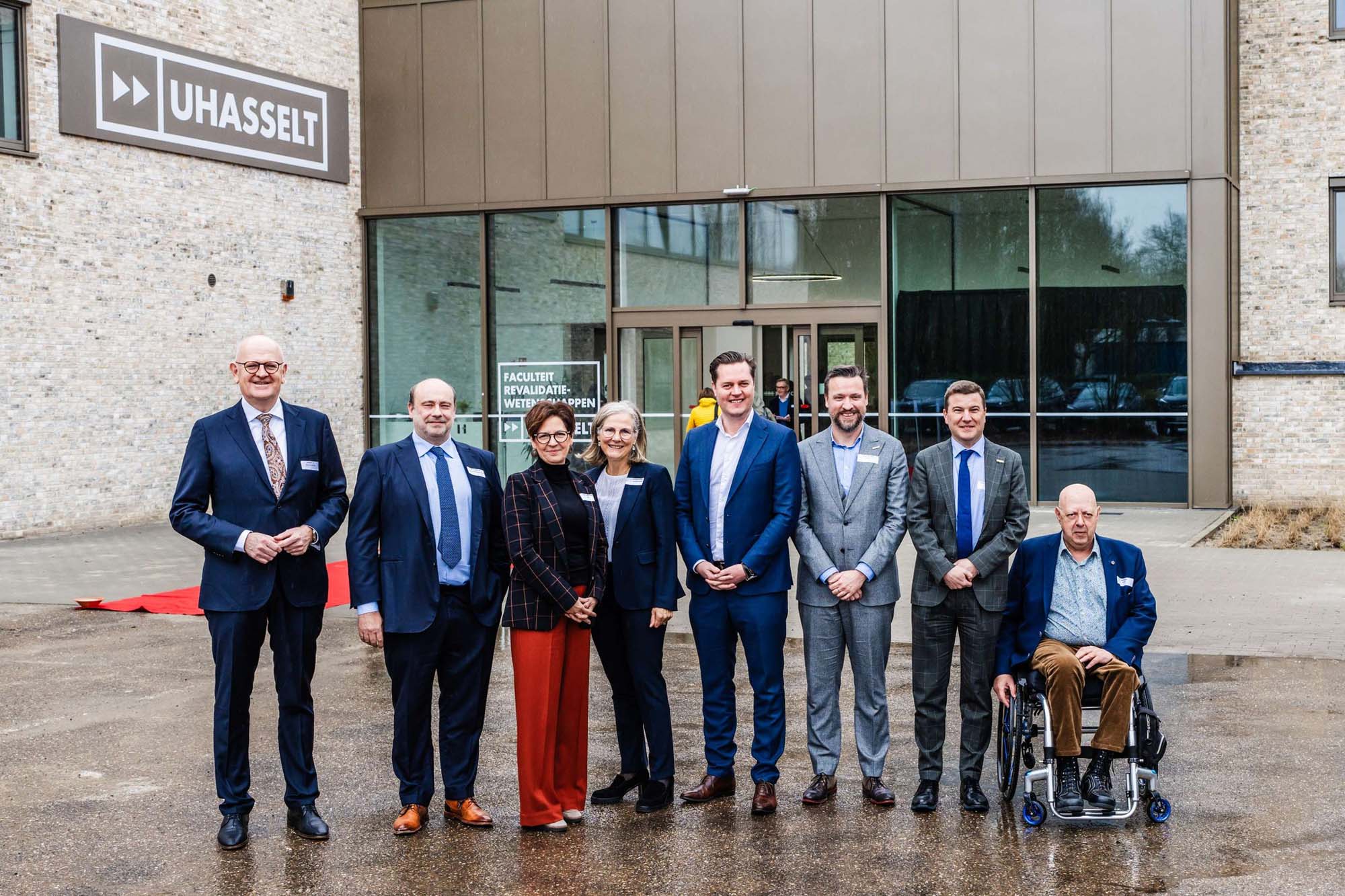
The Faculty of Rehabilitation Sciences at UHasselt has a new home. With the opening of the faculty building on the Health Campus Limburg DC, the faculty is putting more emphasis than ever on the connection with the field and research is getting a solid boost. "In our new labs, we work, among other things, on new rehabilitation techniques for people with MS or diabetes and children with developmental disorders, and conduct research on brain stimulation in rehabilitation," he says. The building also houses the MOVElab. A high-tech movement lab that is unique in Europe," says dean Raf Meesen.
The new faculty building for Rehabilitation Sciences is located on the science park in Diepenbeek. It is immediately one of the central locations of the Health Campus Limburg DC. "With these new facilities for rehabilitation research, we are really taking big steps to position the Health Campus as the centre for innovation in healthcare. Thanks to our cooperation with UHasselt, on the campus we combine academic knowledge with practical experience from industry and the healthcare sector. This fits perfectly with our ambition to have Limburg be at the forefront of that healthcare innovation," says Tom Vandeput, Deputy for Economy and chairman of POM Limburg.
New rehabilitation methods
In addition to office spaces for researchers and support staff, the building has plenty of room for research labs. And with this building, that research gets a solid boost. For instance, REVAL's five expert laboratories can be used both separately and in combination to measure human movement in razor-sharp detail to provide in-depth, fundamental and multifaceted analysis. "For example, here, within the Neurochronometrics expert lab, we will investigate whether you can help people rehabilitate better and faster when you stimulate their brains in a non-invasive way. In addition, numerous research projects are ongoing within the Exercise & Muscle expertise laboratory on diabetes and the physiological composition of muscle tissue," says dean Raf Meesen. "This diversity of laboratories and all their technological innovations ensure that we do not limit ourselves to specific research topics, but rather take a holistic approach where we develop new rehabilitation methods tailored to patients' unique needs."
Unique in Europe
The faculty's flagship research facility will move into the new building at the end of this year. That is when the expert laboratory MOVElab will be installed. This state-of-the-art research infrastructure can count on financial support from ERDF and FIO. "In the unique MOVElab, UHasselt researchers will test and develop new rehabilitation technologies. The project is obviously the merit of UHasselt and its partners, but we support it with great conviction with European funds and from Flanders," says Jo Brouns, Flemish Minister for Innovation.
The MOVElab consists of a high-tech stepping and balancing platform completely surrounded by a dome in which researchers can immerse individuals in a virtual reality environment. "Here we can have individuals perform all kinds of movements that we then record and analyse in detail with high-resolution cameras," says Pieter Meyns, coordinator of the MOVElab. "This will take our research into new rehabilitation techniques to unprecedented heights. I can safely say that with this we will compete at the top academic level worldwide. Because only 9 of these labs exist in the world, in continental Europe we are even going to be the only institution with this infrastructure."
Involving the field
In addition to further expanding research and teaching, the faculty wants the new building to be even more dedicated to engaging the broad field of work within Rehabilitation Sciences. "This new building will be the place that shows what rehabilitation sciences in Limburg stands for. We have the space here to organise lectures and with our Reval Academy we can organise many in-service training courses here. A lot is happening in our field in terms of academic knowledge, so it is important to keep translating it into practice. We do this by offering short training courses and refresher courses to physiotherapists, among others. From now on, we very much welcome them to our new faculty building," concludes Dean Raf Meesen.
The new Rehabilitation Sciences faculty building in figures:
- 4500 m²
- 150 staff
- 18 research laboratories
- total cost of construction project: €7 million
- total cost of MOVElab: 1.6 million euro (ERDF & FIO funds)
 NL
 EN