Starting collaboration for sustainable access and accessibility to Hasselt and Diepenbeek campuses
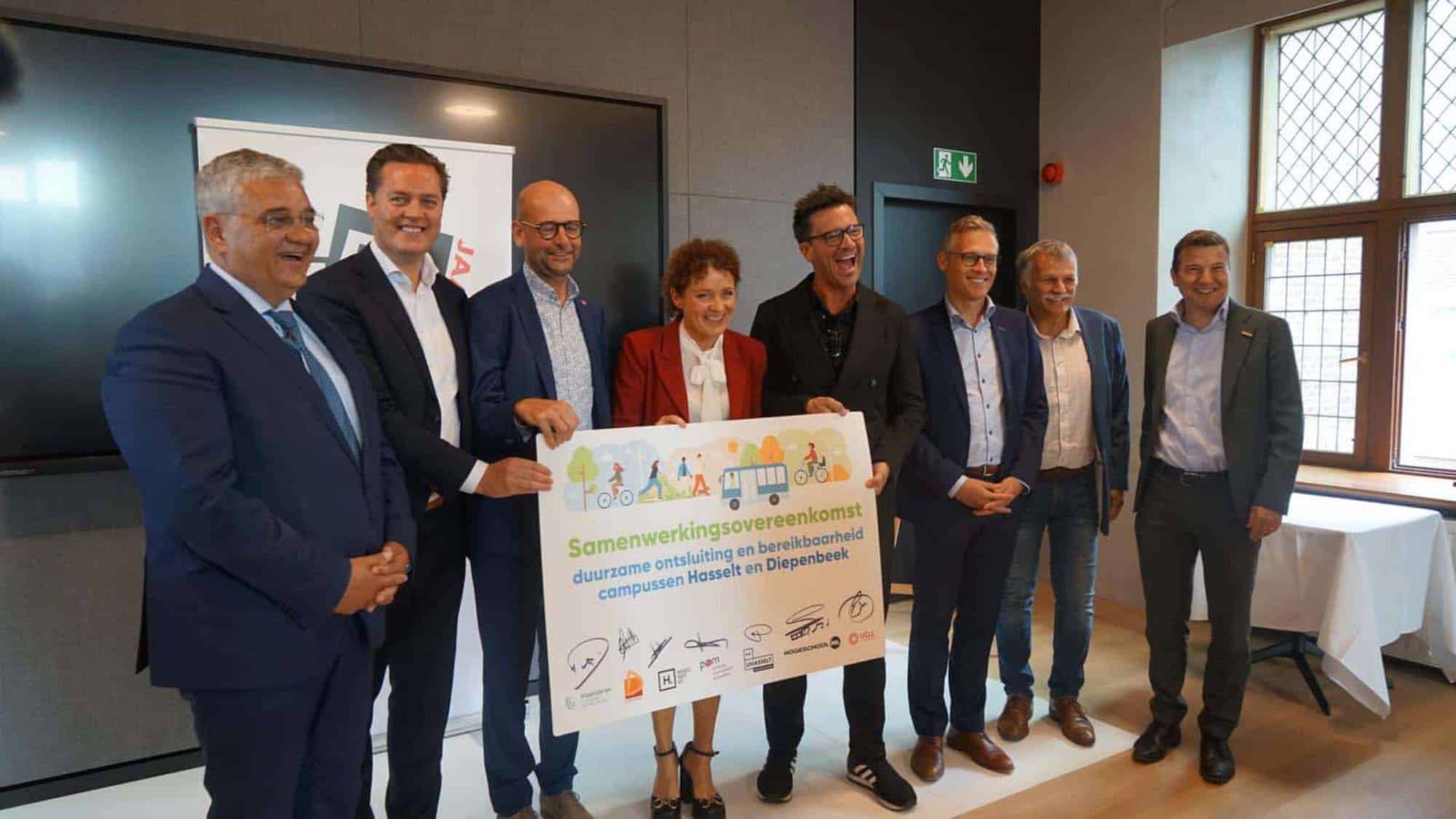
This year, UHasselt, Hogeschool PXL and UCLL together count more than 22,000 students. With the launch of a cooperation between these educational institutions, the city of Hasselt, the municipality of Diepenbeek and POM Limburg, Flemish Minister of Mobility and Public Works Lydia Peeters wants to ensure that students can travel in a sustainable way. All partners signed a cooperation agreement on Monday 18 September. This marks the start of the path towards sustainable access to the campuses and an accelerated modal shift in the wider region. "Limburg is currently still the most car-dependent region. Through the cooperation, we want to strengthen the commitment of all partners to achieve a sustainable and efficient transport policy around the campuses but also in the wider region," said Flemish minister Peeters.
The cooperation agreement has a clear goal in mind: the province of Limburg deserves the sustainable mobility it deserves. The various partners want to jointly tackle the overcrowded car parks at the campuses, reduce traffic congestion during rush hours and also ensure greater road safety for active road users. An integrated approach with the use of high-quality alternatives should bring about a sustainable change.
"Today in Limburg, more than in other provinces, people still take the car for many trips. Especially to and from the education campuses in Hasselt and Diepenbeek, thousands of students and employees commute every day. With this cooperation agreement, we want to boost more sustainable travel by both bicycle and public transport in the coming years." said Minister Peeters.
Transition manager starts working group
Within the predetermined cooperation, minister Lydia Peeters appointed Prof Dr Tom Brijs (IMOB affiliated to UHasselt) as transition manager. A working group is to unite the various forces and visions. Together with his team, Brijs will take on the coordinating and supporting role. Next Wednesday, 20 September, the kick-off meeting will take place after which Prof Dr Brijs and his team can get to work.
"Limburg's education campuses and relevant educational institutions have grown strongly in recent years. They are an important engine for regional development and strengthen the province's international standing. Through this cooperation with all partners involved, we aim to strengthen the accessibility of the education campuses and further build sustainable growth," said Prof. Dr. Tom Brijs.
Better access to campuses
The partners focus on low-traffic landscape campuses with an expanded cycling and pedestrian network and sufficient public transport provision.
Around this opening-up of the campuses, a shared responsibility lies with the Flemish government, the local authorities and the educational institutions. The cooperation agreement should commit all parties to optimising the accessibility and attractiveness of the campuses, now and in the future.
Currently, many projects are already underway or about to start construction. These include the works for the arrival of the first tram buses between Hasselt and Maasmechelen. Currently, De Werkvennootschap is already working on the infrastructure of the free bus lanes on Boudewijnlaan in Hasselt and N702 in Diepenbeek.
In addition, at the start of the academic year, De Lijn launched the kothopper, which will take students from Hasselt station to their kot on Sunday evenings from September.
The city of Hasselt and the municipality of Diepenbeek also already took some measures. To better coordinate mobility projects and works in the future, the different partners will now cooperate even more.
Partners have their say
Commissioner for Economy and chairman of POM Limburg Tom Vandeput: "In the next few years, the Diepenbeek Campus will develop into a centre of knowledge, education and economic activity, with the realisation of a Health Campus and a Construction Campus. This poses major challenges in terms of mobility. Together with Flanders, we therefore want to focus on a modal shift and bring the cars that should still be there to the outside of the campus. In this way, we will create an experience campus where, besides business and education, there is also room for recreation, greenery, student housing and sports."
Mayor of Hasselt Steven Vandeput: "Hasselt continues to grow as a student city. As a city government, we must therefore take all possible flanking measures to provide the best possible environment for students. Good access to our city is part of that. Hence, this cooperation agreement is important. After all, in the future we will offer our students even more good alternatives to the car so that our city centre is relieved and Hasselt remains the pleasant city of experience it is today."
Mayor of Diepenbeek Rik Kriekels: "This cooperation agreement ensures that Diepenbeek will remain easily accessible in the future and that various sustainable modes of transport will be given an extra boost. With the arrival of the first tram buses, we will ensure a smooth connection to and from our municipality. It is important for travellers to be able to travel from point A to B as quickly as possible with a high frequency. Diepenbeek is already a satisfied partner and looks forward to the various joint projects that are also on the table in the future."
General director of UCLL university college Marc Vandewalle: "For students and staff of UCLL University College at the Diepenbeek campus (and our Hasselt campus), easy and fast accessibility is of great importance. After all, many of them do not want to or cannot just go somewhere to live, so good mobility ensures extra Limburg study opportunities. Intensive cooperation between all parties is therefore a good step forward towards sustainable and realistic mobility to a pleasant campus."
Rector of UHasselt Bernard Vanheusden: "I am very happy that with this agreement we can give sustainable mobility a strong boost. It is absolutely necessary to thoroughly invest together in high-quality public transport and pleasant and safe cycling and walking infrastructure. This to better connect our campuses in Hasselt and Diepenbeek, but especially to guarantee smooth travel to and from digs or home."
General director Hogeschool PXL Ben Lambrechts: "Our PXL campuses for research and education in Hasselt and Diepenbeek will be transformed into accessible, vibrant state-of-the-art campuses (and strong ecosystems with the Demer as a connection between the two). This requires coordination between different policy levels and disciplines (mobility, infrastructure, ecology, economy, education ...). We are grateful to the minister for appointing the budget and transition manager to guide this process with vision and direction."
 NL
 EN