First spade cut for Health Campus entrance gate in Diepenbeek
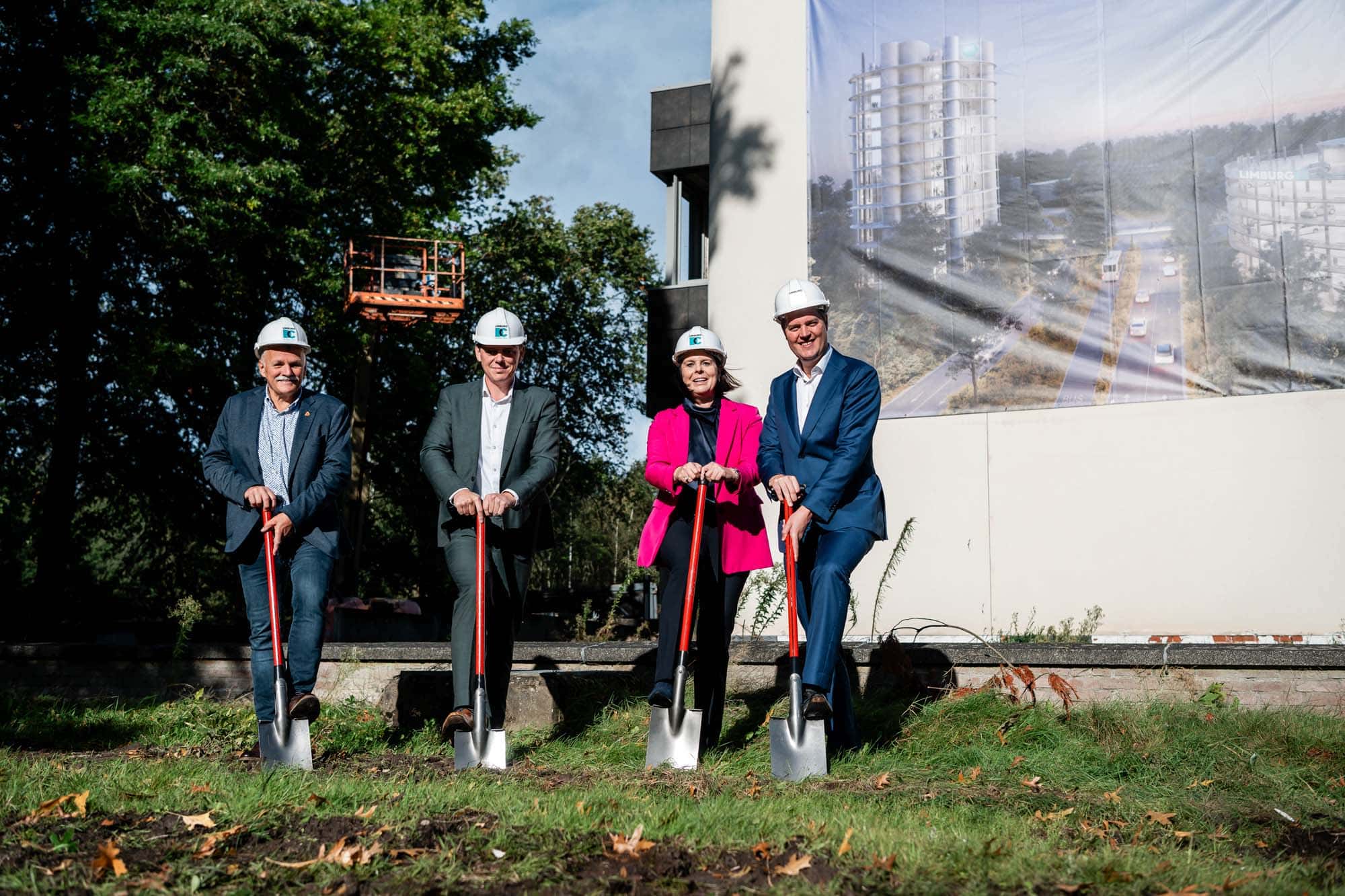
Today, deputy Tom Vandeput and mayor Rik Kriekels gave the first sod for the construction of the entrance gate to the Health Campus in Diepenbeek. The new buildings, developed by POM Limburg in collaboration with UHasselt and with European support, will be the face of the campus. The gateway building will bring together healthcare partners and knowledge institutions to innovate and strengthen the healthcare sector.
As an open innovation centre, the gateway building of Health Campus Limburg DC will provide a place where innovative research, the healthcare sector and industry meet to shape the healthcare of the future.
Commissioner for Economy and chairman of POM Limburg Tom Vandeput: "The healthcare sector is of great economic importance for Limburg, with almost one in five Limburgers working in it. Thanks to digitalisation, we can not only improve the quality of care, but also increase life expectancy."
Minister for Employment and the Economy Jo Brouns underlines the importance of this project for Flanders: "With the Health Campus, we are building further on the innovative ecosystem in Limburg for better healthcare. With the 12.8 million euros of ERDF support, we are happy to contribute to this from Flanders. It ensures that our companies, but also UHasselt, can further build expertise and grow in that biomedical sciences and healthcare sector of tomorrow."
Strong ecosystem for better healthcare
Collaboration between research, healthcare and industry is crucial to meet the challenge in our healthcare system. "With an ageing population, the increase in long-term care and staff shortages, we have no choice but to innovate thoroughly but also sustainably in healthcare. This complex problem can only be tackled through collaboration. Translating good ideas into healthcare application through collaboration is what we will work on in the open innovation centre," said Roeland Buckinx, manager of the Health Campus. "Such a strong ecosystem is in itself an attraction for innovative companies, which will find a place to grow in the BioVille incubator or other business space on campus."
One of the core initiatives that will be located in the building is the THINK3-centre for systems and process innovation at UHasselt. "The THINK³ simulation & innovation lab is a university civic lab for education, research and services in the healthcare sector. With this lab, we want to support (healthcare) organisations with the challenges in healthcare and this by letting healthcare professionals, data scientists, economists and other profiles work together. In the context of healthcare innovation projects, the THINK³ lab already built up a lot of experience in developing and implementing innovations in the healthcare sector, together with healthcare professionals from the sector. In addition to the THINK3-centre, UHasselt also sees opportunities for research and services in (bio)medical sciences, rehabilitation sciences, data sciences and broader life sciences with the expansion of the Health Campus," says Prof Veerle Somers, dean of the Faculty of Medicine and Life Sciences.
Panoramic views and green mobility
The gatehouse will be more than just a gateway to the campus. It will include an auditorium with a panoramic view of the entire site, which will further connect the campus with its surroundings. The building will play a central role in the appearance of the entire Diepenbeek Limburg DC campus, with its impressive architecture and green frame. "This tower will be the face of Limburg DC and reflect our ambitious goals. With its striking design, it will above all be a real eye-catcher," said Tom Vandeput.
Adjacent to the gatehouse will be a sustainable parking building, where visitors can exchange their cars for bicycles or scooters. The building will also provide space for catering facilities and will be equipped with charging points for electric vehicles and solar panels, contributing to the campus' sustainable ambitions.
Mayor of Diepenbeek Rik Kriekels: "The Health Campus is a huge added value for Diepenbeek. It offers new opportunities for employment and innovation in the healthcare sector. Moreover, this project creates a unique connection between science, business and our local community. The sustainable and progressive approach of the campus fits perfectly with our vision of a green and future-oriented municipality."
Construction takes two years
The realisation of the gatehouse, designed by the Paris-Ghent architectural consortium Muoto-Tab, will be carried out by contractors Vanderstraeten from Lummen and Cordeel from Temse. Construction is expected to take two years.
The total cost for the gateway is 41 million euros. The project is made possible with provincial support (13.7 million euros), support from LSM (2.5 million euros) and support from the European Regional Development Fund (ERDF) and the Flemish government (12.5 million euros).
 NL
 EN