Three construction teams selected for Building Campus 2.0
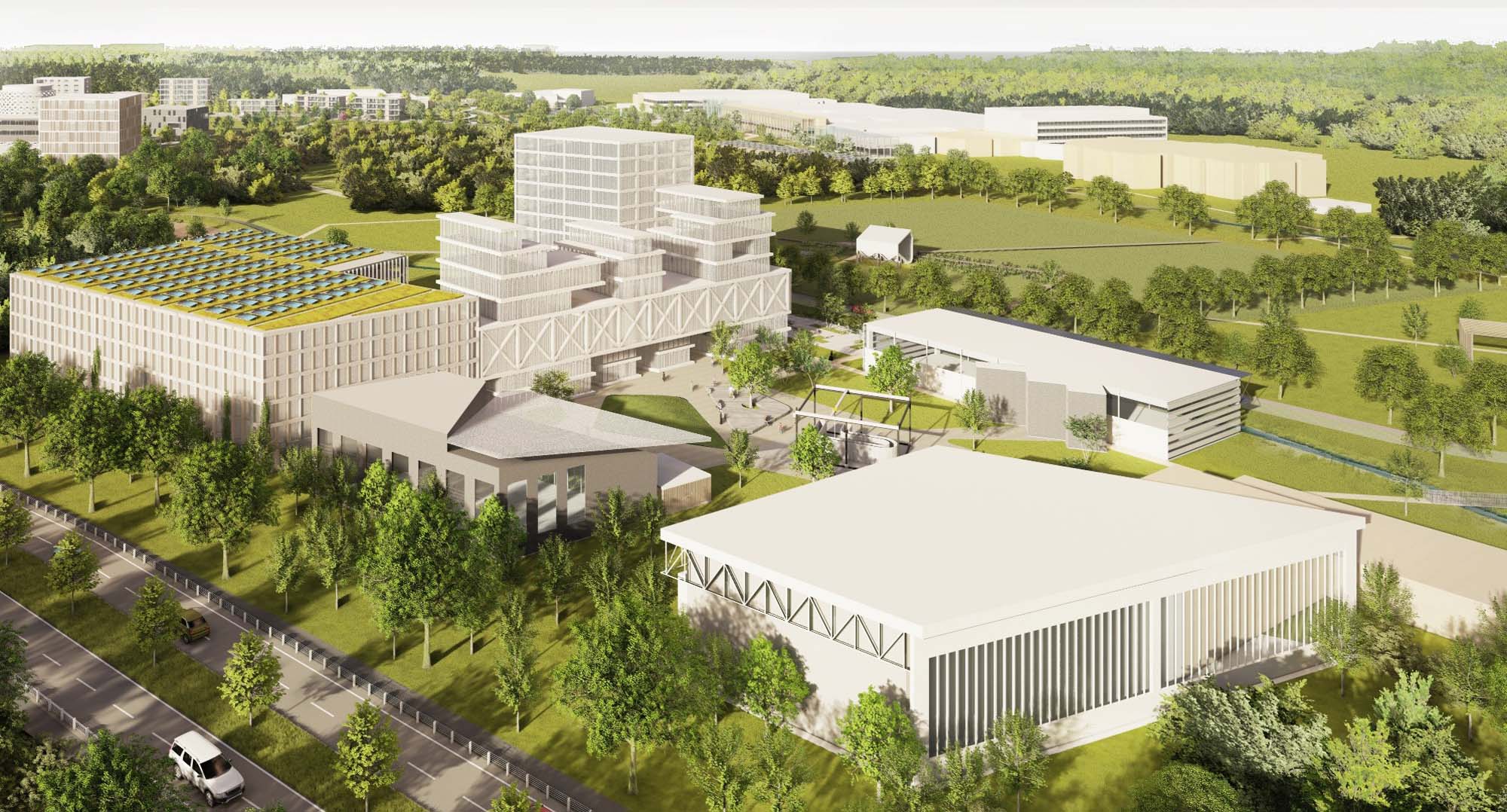
The search for an architect and contractor for Building Campus 2.0 in Diepenbeek is entering its next phase. Three teams still have a chance of winning the contract. The new campus will be built as sustainably as possible, based on circular and modular building principles.
Construction Campus 2.0 is one of the two major themed campuses that POM Limburg is developing at Limburg DC, alongside the Health Campus. The aim is to make the Construction Campus the centre of innovation in construction. Therefore, the campus will be built with minimal ecological impact, following the principles of circular and modular construction. It will be a showcase of innovation, far-reaching sustainability and flexibility.
Three teams
Three teams formed from several Flemish and Limburg construction companies and submitted their applications. Three of these candidates were selected: Construction Campus nxt, Stadsbader DBV Rau and Team Pomme.
- Construction campus nxt: Construction company Dethier ∙ Vanhout ∙ A2O Environment ∙ Broekbakema
- Stadsbader DBV Rau: Stadsbader ∙ Rau Architects ∙ DBV Architects
- Team Pomme: Jansen Building Projects ∙ Houben ∙ Cuypers & Q Architects ∙ A-tract Architecture
POM Limburg is opting for a competitive dialogue. Instead of the traditional tender procedure, POM will enter into dialogue with the entire construction team in several rounds of talks. The aim is to explore the various innovative possibilities in the field of sustainable and circular construction together with the architect and contractor.
Leader
Building Campus 2.0 will be all about innovative experiments. Various players from the construction sector will meet and exchange knowledge on the campus. For years, the sector has been fighting a high mountain of waste and low profitability, two major challenges that require a major transition to digital and circular construction. With Building Campus 2.0 as its flagship, Limburg aims to become a leader in this field.
Doing more with less space
To reduce the ecological footprint of the campus, the "do more with less space" principle applies. Among other things, this means building as much as possible in height, on top of existing paving. The building will also be modular, allowing it to be quickly adapted to other forms or functionalities with minimal technical interventions. Sustainable energy will also receive a lot of attention, and circular building principles will be integrated as much as possible.
 NL
 EN