UHasselt opens groundbreaking VR motion lab
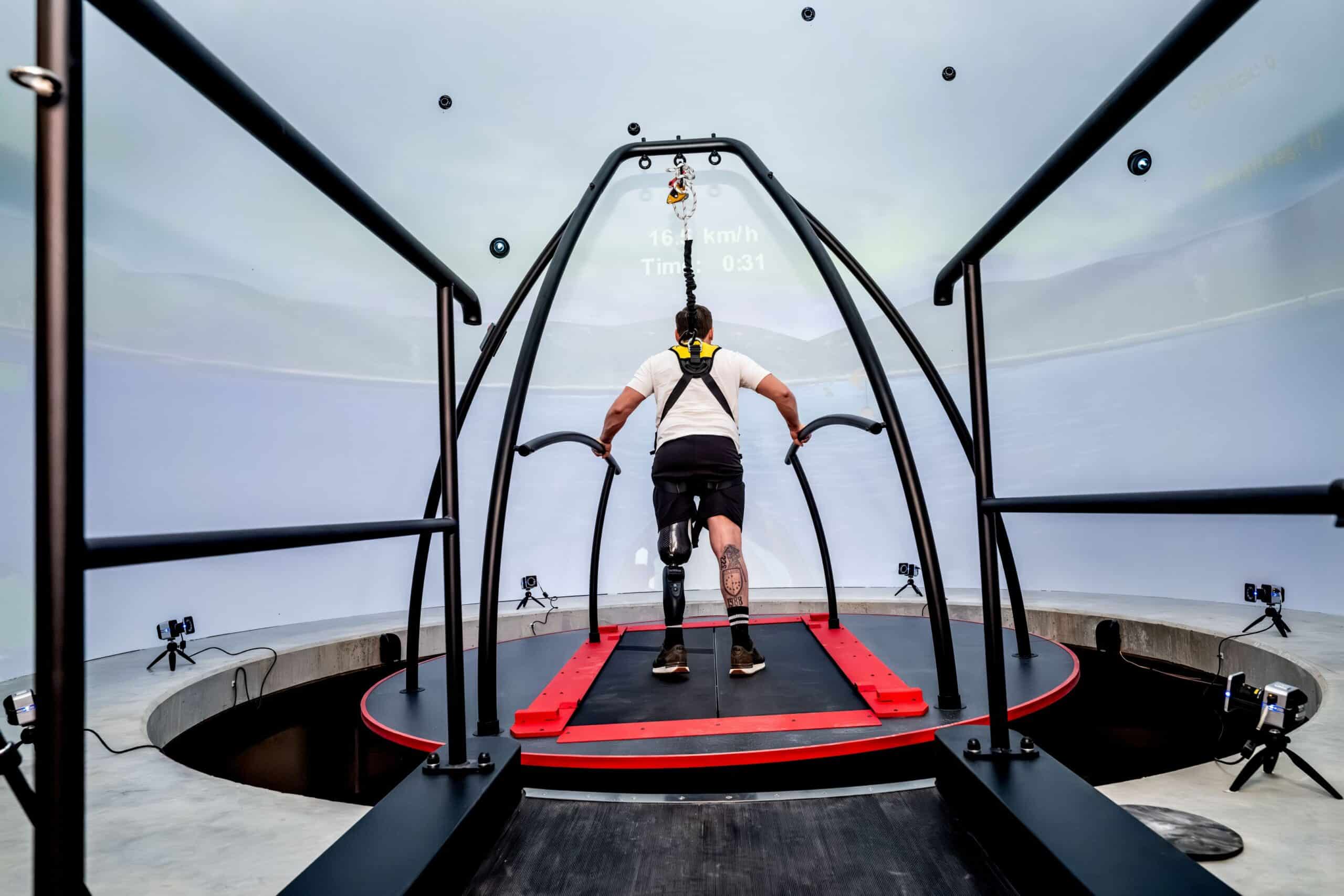
From fall prevention to elite sports: unique European VR lab takes rehabilitation to next level
The Faculty of Rehabilitation Sciences at UHasselt proudly presents its MOVElab. A high-tech research lab in a large 300-degree dome with a movement platform in the middle. "In the dome, we can immerse test subjects ranging from patients to top athletes in a virtual environment, after which we use our platform to simulate disturbances such as falls or balance problems. Every movement or reaction of the subject is analysed in detail with infrared cameras to develop new rehabilitation techniques," says coordinator Prof Dr Pieter Meyns. The MOVElab is unique for continental Europe, worldwide there are only 9 similar installations.
From research into fall prevention in the elderly to virtual training camps for children with motor problems, and from rehabilitation for top athletes and people with chronic conditions to the development of new running shoes or prostheses. The possibilities in the MOVElab are endless. "The MOVElab is the most advanced biomechanical movement laboratory in the world" says Prof Pieter Meyns. "The lab is equipped with a giant dome in which you can literally step into a virtual world that feels lifelike. It has a motion platform that can move in all possible directions and numerous infrared cameras to analyse a subject's movements and behaviour in detail."
Unique in continental Europe
The MOVElab is unique to continental Europe and only 9 similar installations exist worldwide. The movement lab has a cost of €1.6 million and is funded by the European Regional Development Fund (€400,000), by Flanders through the Fund for Innovation and Entrepreneurship (€400,000) and by UHasselt as project partner.
"This unique movement lab once again demonstrates our rock-solid position on innovation and also strengthens our image as a knowledge region and European innovation leader," said Flemish minister-president Matthias Diependaele. "From Flanders, we invest a lot of resources in research at various knowledge institutions. To tackle our societal challenges, such innovative approaches are incredibly important."
"Movelab is a bold and concrete realisation of the goals of the SALKturbo strategy, which we can realise thanks to the support of Europe and Flanders. This high-tech movement lab is not only a breakthrough for rehabilitation research, but also a catalyst for innovation in the health and sports sector. The combination of virtual reality and biomechanical analysis opens new doors for patients, athletes and companies. This is exactly the kind of progress we want to encourage at the Health Campus Limburg DC: groundbreaking research with a tangible impact on society," said Tom Vandeput, deputy for Economy and chairman of POM Limburg.
Fall prevention
One of the first studies now starting up at the MOVElab is about teaching elderly people skills to resist falling. "For the elderly, a fall can really be the beginning of a downward spiral. Together with Maastricht University, we are therefore investigating in the MOVElab how to improve the fall resistance of over-65s through VR simulations. In doing so, we train them to anticipate obstacles, react to minor disturbances such as bumping into something and deal with major balance disturbances that throw them completely off balance. Because the test subjects wear a harness, we can simulate all these disruptions safely in the VR dome on our motion platform. We then further translate the insights we gain from this into accessible, affordable training programmes for physiotherapists and healthcare professionals."
Developing innovations
Furthermore, research projects on rehabilitation techniques for people recovering from stroke, people with MS, children suffering from the developmental disorder DCD and people with balance disorders are also starting up in the MOVElab. In addition, the researchers are also looking at collaborations with companies to develop new applications and products in the MOVElab. "Our platform cannot only be used for the development of new therapies or training programmes, numerous innovative products such as measuring sensors or new prostheses can also be tested here," says Dr Yvette Kerkum, who as business developer is responsible for valorisation within the Faculty of Rehabilitation Sciences.
Pearl for Health Campus Limburg DC
"For our faculty, the arrival of the MOVElab is a real dream. This is really a gem in terms of high-level research infrastructure, putting our research on the European and world map. And our goal goes beyond innovations in rehabilitation. We want to make the MOVElab a dynamic hub where science and technology reinforce each other. This infrastructure will therefore be a great asset on the Health Campus Limburg DC," concludes Prof Raf Meesen, dean of the Faculty of Rehabilitation Sciences.
 NL
 EN